
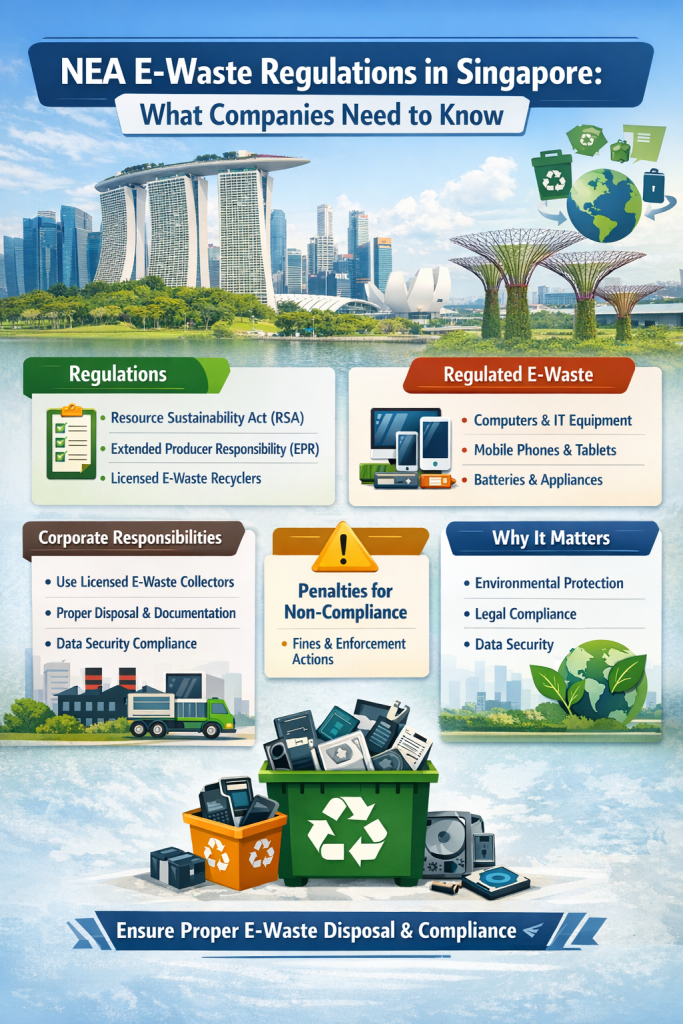
If your business regularly replaces computers, phones, or office equipment, you’re generating e-waste and in Singapore, that comes with legal responsibilities most companies still underestimate.
E-waste, or electrical and electronic waste, covers everything from laptops and mobile devices to printers, servers, and batteries. These items contain a mix of recoverable materials and hazardous substances like lead and mercury, which is exactly why Singapore does not leave their disposal to chance.
The Legal Framework: RSA and the EPR Approach
The Resource Sustainability Act (RSA), introduced by the Ministry of Sustainability and the Environment, is part of Singapore’s strategy to build a sustainable, resource-efficient and climate-resilient nation. The Act gives legislative effect to regulatory measures targeting three priority waste streams: e-waste, food waste, and packaging waste. National Environment Agency
At the core of the e-waste system is the Extended Producer Responsibility (EPR) framework. Under the EPR framework, producers of regulated electrical and electronic products are made responsible for the collection and proper treatment of their e-waste. National Environment Agency (NEA) administers and enforces these requirements.
On 11 February 2021, ALBA Group was awarded the tender for the licence to operate the Producer Responsibility Scheme (PRS) for a period of 5 years, from 1 July 2021. ALBA E-Waste Smart Recycling is responsible for organising the collection and recycling of consumer e-waste across Singapore on behalf of producers.
Who Is Regulated?
Regulated products cover a broad range: ICT equipment such as computers and laptops, mobile phones, televisions, refrigerators, air-conditioners, lamps, batteries, and solar photovoltaic panels. Producers who manufacture or import these items for local supply must register with NEA and meet reporting obligations.
Retailers are not off the hook either. All retailers of regulated consumer products are required to provide free one-for-one take-back services during delivery. Large retailers with a floor area of 300 sqm and above are required to set up in-store e-waste collection points for ICT equipment, lamps, and batteries. National Environment Agency
Producers supplying less than a specified threshold amount of covered electrical and electronic equipment to the local market are exempted from financing the PRS, but are still required to register with NEA and report the amount of covered equipment they supply to the local market annually. Ministry of Sustainability and the Environment
What This Means for Corporate E-Waste Generators
Even if your company is not a producer or importer, you still have obligations when it comes to disposing of your own IT assets. Businesses cannot simply toss old equipment into general waste bins. Only NEA-licensed collectors and recyclers can legally handle e-waste.
This matters most during IT refresh cycles or office relocations, when large volumes of equipment get cleared out quickly. That is precisely when corners get cut, and when the risk of non-compliance is highest.
Unregistered producers who continue to supply regulated electronic products, or registered producers who fail to maintain records, are liable under the RSA for a fine not exceeding $10,000 or imprisonment of up to 3 months, or both. National Environment Agency
Data Erasure Is a Legal Requirement, Not Just Good Practice
Here is something many businesses miss: data erasure is not just an internal IT policy. Under the Resource Sustainability (Prescribed Regulated Products) Regulations, Licensed recyclers are required under regulations to ensure data is permanently erased or destroyed before reuse, recycling, or disposal. Violation of this regulation can result in a fine of up to $10,000. National Environment Agency
This means the obligation to ensure data is properly handled does not end when the device leaves your office. You need to work with a licensed recycler who complies with these requirements and can provide documentation to prove it. Under the Personal Data Protection Act (PDPA), your company can still be held accountable for a breach if devices are not properly wiped before disposal.
Practical Steps for Businesses
Getting compliant is more straightforward than most expect. Here is where to start:
- Identify all e-waste streams across your operations, including accessories, cables, and power banks that are easy to overlook
- Separate e-waste from general waste at the point of collection, they cannot be co-mingled
- Engage only NEA-licensed e-waste collectors or recyclers, do not hand devices to unlicensed vendors even if they offer free collection
- Ensure data is securely erased or destroyed before any device leaves your premises, and get it in writing
- Keep records and disposal certificates for audit purposes, especially after bulk IT disposal exercises
- Review your disposal process at the start of every IT refresh cycle, not after the equipment has already been cleared out
The Bottom Line
The implementation of a regulated e-waste management system in Singapore ensures the proper and safe handling and extraction of resources from e-waste, and funds the recovery of valuable materials for reuse. National Environment Agency For businesses, this means e-waste disposal is no longer something you can handle informally or ad hoc.
Getting it right comes down to three things: knowing who to engage, keeping proper records, and not treating old IT equipment as an afterthought. The paperwork trail you build now is the same one that protects you during an audit later.