
Document Shredding in Singapore: Complete Guide for Companies
Even as businesses move towards digital records, many companies in Singapore still handle large amounts of confidential paper documents.
These may include accounting files, HR records, customer forms, contracts, invoices, medical records, bank statements, payroll documents and archived business files.
If these documents are thrown into normal rubbish bins or recycling bins without proper destruction, sensitive information may be exposed. This can lead to data leaks, reputational damage and compliance risks.
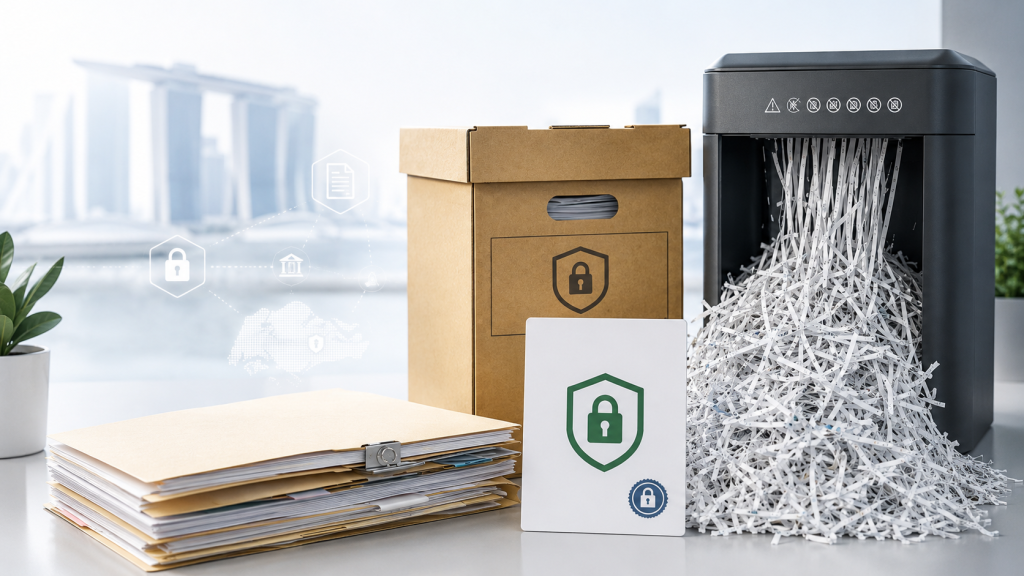
Shredding your documents is one of the most practical ways for companies to dispose of confidential paper records securely.
This guide explains why document shredding matters, what documents should be shredded, how the process works and what to look for in a shredding service provider in Singapore.
Why document shredding matters
Document shredding is the process of destroying paper documents so that the information on them cannot be easily read, copied or misused.
For companies, this is important because paper documents may contain:
- customer personal data
- employee records
- NRIC or FIN details
- invoices and payment records
- contracts and agreements
- bank statements
- medical or insurance records
- payroll information
- internal reports
- confidential business plans
If these documents are mishandled, they may expose the company to unnecessary risk.
In the past, some businesses treated old paper records as general waste or sold them as scrap paper. This is risky because there may be no proper chain of custody, no secure destruction process and no proof that the documents were actually destroyed.
For confidential documents, secure shredding is a safer and more accountable disposal method.
Document shredding and PDPA in Singapore
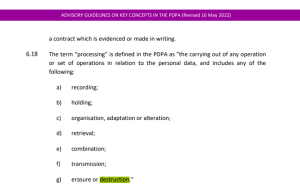
Singapore’s Personal Data Protection Act, or PDPA, requires organisations to make reasonable security arrangements to protect personal data in their possession or under their control.
This applies to both digital and physical records.
A printed customer form, HR file, delivery order or medical document may contain personal data. If such documents are no longer needed and are disposed of carelessly, the company may create a data protection risk.
The PDPA also includes a retention limitation obligation. In simple terms, organisations should not keep documents containing personal data longer than necessary if there is no legal or business reason to continue retaining them.
Secure document shredding helps companies reduce the risk of personal data being exposed after documents are no longer needed.
What documents should companies shred?
As a simple rule, any document containing personal data, financial information, business-sensitive information or confidential records should be shredded before disposal.
Common examples include:
- accounting records
- invoices and receipts
- bank statements
- HR files
- payslips and payroll records
- CPF-related records
- employee personal particulars
- customer application forms
- medical records
- insurance records
- contracts
- legal documents
- internal reports
- tender documents
- expired business files
- archived storage boxes
For individuals, documents such as bank statements, insurance letters, medical records, utility bills and documents containing NRIC numbers or addresses should also be shredded before disposal.
How long should company documents be kept before shredding?
Not every old document should be shredded immediately.
Some records must be kept for a minimum period before they can be disposed of.
For example, IRAS requires Singapore companies to keep proper records and accounts for at least 5 years from the relevant Year of Assessment.
These records may include source documents, accounting records, schedules, bank statements and other transaction records connected with the business.
This means companies should have a simple retention process before arranging shredding.
A practical approach is:
- identify the document type
- check the required retention period
- confirm there is no ongoing legal, tax, audit or business reason to keep it
- securely shred the document once it is no longer required
- keep a destruction record or certificate where appropriate
For a more detailed breakdown, refer to our guide on how long company documents should be kept in Singapore before shredding.
On-site vs off-site document shredding
There are generally two common types of document shredding services: on-site shredding and off-site shredding.
On-site shredding
On-site shredding means the shredding is carried out at the customer’s premises, usually using a mobile shredding truck.
The main benefit is that the customer may be able to witness the destruction process directly.
However, on-site shredding may not always be practical depending on volume, location, access restrictions and service availability.
Off-site shredding
Off-site shredding means the documents are collected from the customer’s location and transported to a secure facility for destruction.
This is a common option for companies clearing archive boxes, storage rooms or larger volumes of paper records.
A proper off-site shredding process should include secure collection, proper handling, controlled transport, destruction at the facility and a Certificate of Destruction after completion.
For many companies, off-site shredding is a practical option because it saves staff time and avoids overloading office shredders.
Why a normal office shredders may not be enough
Office shredders can be useful for small daily disposal tasks.
However, they are usually not suitable for bulk document clearance.
Common problems include:
- slow shredding speed
- overheating
- paper jams
- limited bin capacity
- need to remove staples or clips
- staff time spent feeding paper manually
- inconsistent disposal records
For companies with many boxes of documents, outsourcing the shredding process is usually more efficient.
It also allows staff to focus on their actual work instead of spending hours feeding documents into a small shredder.
What happens during a professional shredding service?
A professional document shredding process may include the following steps:
- The company identifies documents ready for disposal.
- Documents are packed into boxes, bags or bins.
- Collection is arranged with the shredding provider.
- Documents are collected and transported for destruction.
- Documents are shredded using industrial shredding equipment.
- Shredded paper is sent for recycling where appropriate.
- A Certificate of Destruction is issued after completion.
For sensitive documents, companies should make sure boxes, bags or bins are sealed properly and not left unattended before collection.
Why chain of custody matters
Chain of custody refers to the handling and tracking of documents from collection to destruction.
This matters because confidential documents are still sensitive before they are shredded.
A proper chain-of-custody process may include:
- GPS tracked vehicles
- sealed boxes, bags or bins
- controlled handover
- trained collection staff
- destruction at the facility
- certificate or disposal record after completion
The goal is to reduce unnecessary exposure and provide accountability throughout the disposal process.
Certificate of Destruction
A Certificate of Destruction is a document issued after the shredding service is completed.
It may include information such as:
- customer name
- date of collection or destruction
- type of material destroyed
- quantity or estimated weight
- service reference number
- confirmation that destruction was completed
For companies, this certificate can be useful for internal records, audits and compliance documentation.
It does not replace legal advice or regulatory compliance work, but it helps show that the company arranged proper destruction of confidential documents.
Document shredding and recycling
Document shredding can also support recycling.
After documents are shredded, the paper may be sent for recycling where appropriate. Recycled paper can be used in products such as paperboard, packaging or other paper materials.
This allows companies to dispose of confidential documents securely while reducing unnecessary waste.
However, security should come first. Confidential documents should not be placed directly into general recycling bins before they are shredded.
How to choose a document shredding service in Singapore
Before choosing a shredding company, consider the following:
| What to check | Why it matters |
|---|---|
| Secure collection process | Reduces risk during handover and transport |
| Experience with corporate clients | Important for bulk archive clearance |
| Certificate of Destruction | Provides documentation after completion |
| Clear pricing | Helps avoid confusion on collection and disposal costs |
| Proper handling of documents | Reduces risk of exposure before shredding |
| Recycling support | Helps reduce waste after secure destruction |
| Responsiveness | Important when companies need urgent clearance |
Avoid choosing a shredding provider based only on the lowest price.
For confidential documents, the process, handling and documentation are just as important as the cost.
Common document shredding mistakes to avoid
Companies should avoid these common mistakes:
- throwing confidential documents into normal rubbish bins
- placing personal data directly into recycling bins
- selling confidential paper records as scrap paper
- leaving archive boxes unattended before collection
- shredding documents before checking retention requirements
- keeping old documents indefinitely without review
- failing to keep a destruction record
- using office shredders for large archive clearances
- mixing paper documents with IT assets that require data destruction
Document shredding and IT assets
Some office clearances involve both paper documents and old IT equipment.
This is important because laptops, hard drives, SSDs, USB drives and mobile phones may also contain confidential information.
These items should not be treated the same way as paper documents.
Paper records should be shredded. Data-bearing IT assets should go through proper data erasure, hard drive destruction, degaussing or IT asset disposal, depending on the type of device and whether it will be reused.
Frequently asked questions
What is document shredding?
Document shredding is the destruction of paper documents so that the information on them cannot be easily read, copied or misused.
Why do companies need document shredding?
Companies need document shredding to protect confidential information, reduce data leakage risk, support compliance practices and dispose of old paper records securely.
Can I throw confidential documents into the recycling bin?
No. Confidential documents should be shredded before recycling. Placing them directly into a recycling bin may expose personal or business-sensitive information.
What documents should be shredded?
Documents containing personal data, financial information, HR records, customer details, contracts, medical information, bank details or confidential business information should be shredded before disposal.
How long should accounting documents be kept before shredding?
Singapore companies generally need to keep proper accounting records and source documents for at least 5 years from the relevant Year of Assessment. The exact retention period depends on the type of document and the company’s legal, tax or business requirements.
Is off-site shredding safe?
Off-site shredding can be safe if the provider has proper collection, transport, handling, destruction and documentation processes. Companies should check how documents are handled before destruction.
What is a Certificate of Destruction?
A Certificate of Destruction is a document issued after shredding is completed. It provides a record that documents were collected and destroyed.
Can shredded paper be recycled?
Yes, shredded paper may be sent for recycling where appropriate. However, confidential documents should be shredded first before recycling.
Secure document shredding in Singapore
Arkiva provides secure document shredding services for businesses in Singapore.
We help companies dispose of confidential paper records, archive boxes, HR files, accounting documents, contracts and other sensitive documents securely.
Our services include:
- off-site document shredding
- archive box disposal
- confidential paper destruction
- Certificate of Destruction
- recycling support where appropriate
- secure handling of business records
Need help clearing old documents or archive boxes?
Contact Arkiva for a quotation.
Email: sales@arkiva.com.sg
Phone: 6871 8789
Disclaimer
This article is for general informational purposes only and does not constitute legal, tax, compliance or PDPA advice. Retention requirements may vary depending on the document type, industry and business situation. For specific advice, consult your legal adviser, tax adviser, Data Protection Officer or relevant regulator.